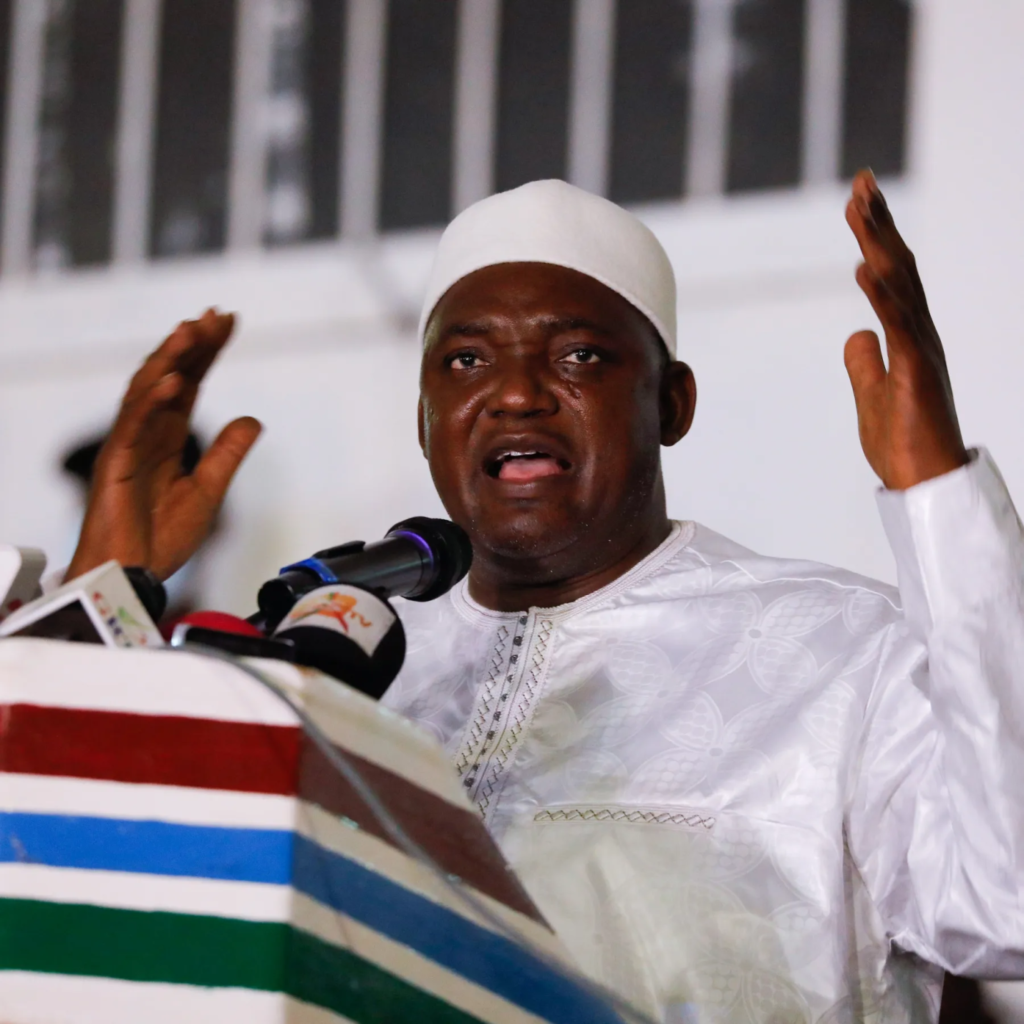
Photo: President Adama Barrow, Photo Credit Aljazeera
By: Ousman A. Marong
There is a name that should make every law-abiding Gambian stop and think. Not because it is funny, fashionable or youthful slang, but because of what it stands for: “The Outlaw.”
By definition, an outlaw operates outside the law, defies authority and rejects the rules that hold society together. So it is hard to understand why a group involved in dangerous drifting on public roads would proudly choose that name and expect the country’s highest office to embrace them.
Yet that is exactly what has happened.
President Adama Barrow has reportedly welcomed the group to State House, given them D500, 000, invited them to his nomination ceremony and said he is willing to consider pardoning members convicted in connection with their activities.
These gestures raise serious questions about the President’s judgment, public safety and the message being sent to a country already dealing with the consequences of reckless drifting on its roads.
The question is not whether young people deserve support, motorsport should be recognized or the government should invest in recreational opportunities. They do. The real question is whether State House should lend its prestige, resources and political goodwill to a group whose chosen identity openly celebrates defiance of the law.
President Barrow has reportedly warned the group against using the term “Outlaw”, saying that nobody is above the law in The Gambia—not even ministers. If that is his understanding of the law, his actions should reflect the same principle.
You cannot condemn lawlessness in words while appearing to reward it through presidential gestures.
Why should a group be given a presidential reception, financial support and political recognition while concerns about its identity remain unresolved? And why should the State House offer such a platform before making it absolutely clear that dangerous activities on public roads will not be tolerated?
Youth empowerment should never be used to justify rewarding behavior that puts other people’s lives at risk.
Where Was the Same Compassion for the Victims?
Perhaps the most troubling part of this episode is the apparent lack of equal presidential attention to those harmed by reckless drifting.
The nation deserves to ask a simple, painful question: Did President Barrow show the same generosity, attention and compassion to the woman reportedly struck by drifters and left without both legs?
Did he visit her in hospital? Did he help with the cost of her medical treatment? Did he meet her family, hear about their suffering and show that the presidency stands with citizens whose lives have been devastated by reckless behavior?
If no similar gesture was made, the contrast is hard to ignore.
A woman reportedly lost both legs in an incident linked to dangerous drifting. Her life and her family’s lives have been profoundly changed. Yet, as the country continues to face the consequences of these incidents, a group associated with the controversial activity receives a State House reception and D500, 000.
What does this say about our national priorities?
A presidency should be judged not only by how warmly it welcomes influential groups, but also by how compassionately it responds to ordinary citizens whose lives have been shattered.
Victims of reckless drifting deserve more than sympathy from the public. They deserve recognition, support and justice. Their suffering must not be brushed aside simply because people connected to the activity have gained access to those in power.
For many Gambians, the timing and nature of the President’s gestures risk giving the impression that political consideration are being placed ahead of public safety, particularly as the December 5 presidential election approaches.
The presidency must recognize that young people are not empowered by being encouraged, openly or indirectly, to put public safety at risk. Real empowerment means creating opportunities, encouraging responsibility and protecting lives.
Public Roads Are Not Racing Circuits
Let us be clear: drifting is not inherently wrong as a motorsport. It is a recognized sporting activity that can be practiced responsibly in designated areas, provided the right safety rules are in place.
But public roads are not racing circuits.
Pedestrians, schoolchildren, traders, cyclists, motorists and families all rely on these roads in their daily lives. A reckless manoeuvre performed for entertainment or applause can leave someone permanently disabled, seriously injured or dead.
For the woman reportedly left without both legs, the consequences are no longer hypothetical. Her experience is a painful reminder that what some people see as entertainment can become a family’s lifelong tragedy.
No amount of excitement, popularity or political patronage can justify putting innocent people in such danger.
If the government genuinely wants to support motorsport enthusiasts, it should establish a properly designated, regulated racing facility. It should have adequate barriers, emergency medical services, police supervision, insurance arrangements and the necessary safety infrastructure.
If the association has requested such a facility, the government should take the proposal seriously. It would give young people a legitimate place to pursue their passion.
It would give people a legitimate place to pursue their passion without turning public roads into dangerous playgrounds.
Until such a facility is available, there is no justification for dangerous drifting on public highways.
The Police Must Not Become Selective Enforcers
The Gambia Police Force (GPF), also has some serious questions to answer.
Law enforcement loses credibility when it appears inconsistent. If drifting on public roads is prohibited because it endangers pedestrians and other road users, the rule must apply to everyone.
The police must not seem tough on ordinary citizens but reluctant to act when those involved have political connections or public recognition.
Communities have repeatedly raised concerns about dangerous road activities and the need for prompt intervention. Authorities must show that protecting lives is a priority—not something they consider only after an accident.
An invitation to State House does not grant immunity. Financial assistance from the President does not put anyone above the law. Nor should political connections affect how public safety rules are enforced.
The police must apply the law impartially, investigate reported incidents and ensure that anyone found responsible is held accountable through the proper legal process.
The law must not fall silent because an election is approaching.
Gambian Youths Must Take Responsibility for Their Communities
This editorial is also a call to young people across The Gambia.
Do not let dangerous behavior become accepted in your communities. Popularity is not the same as responsibility, and political recognition does not permit anyone to put others at risk.
The example set by young people in Gunjur shows how communities can stay alert and take responsibility together. Communities should be encouraged to organise peacefully, work with local authorities and refuse to let their streets be taken over by activities that threaten public safety.
Young people can take practical steps:
Organize peacefully: Work with Alkalos, elders, community leaders and youth associations to set up lawful community vigilance initiatives.
Document and report dangerous activities: When it is safe and lawful, record incidents, note the dates and locations, and report reckless drifting to the police promptly, use maximum force if necessary.
Protect vulnerable road users: Look out for children, pedestrians, traders and other residents when dangerous activities are reported in the neighborhood.
Demand designated motorsport facilities: Support legitimate sporting activities, but insist that they take place in properly equipped and regulated settings.
Reject violence and vigilantism: Community vigilance must never be used as an excuse to take the law into your own hands. Enforcement is the responsibility of the relevant authorities. Should they failed you decide.
The aim is not to wage war on young people or deny them recreational opportunities. It is to defend every Gambian’s right to use public roads without fear of being injured by reckless behavior.
Mr President, The Victims Must Come First
President Barrow must understand that leadership is about more than welcoming groups to State House, distributing financial assistance or appearing alongside popular youth movements. It means setting standards, protecting the vulnerable and making sure the law applies equally to everyone.
If the President truly believes that no one is above the law, his actions should reflect that belief.
He should show the same urgency and compassion toward the victims of reckless drifting as he has shown toward those involved in it. He should visit the woman reportedly left without both legs, offer meaningful support to her and her family, and make clear that the suffering of ordinary Gambians matters to his government.
He must also be unequivocal: no person or group should receive special treatment because of political ties, campaign support or access to State House.
There is nothing wrong with empowering young people. But there is everything wrong with appearing to endorse behavior that puts innocent lives at risk.
The Gambia needs responsible leadership, not mixed messages. It needs a government that rewards discipline, encourages lawful recreation and stands firmly with the victims of preventable tragedies.
You cannot call yourselves “Outlaws,” celebrate activities that endanger lives and expect State House to lend you political legitimacy without facing difficult questions.
Nor can a President preach equality before the law while risking the impression that some groups receive greater access, compassion and consideration than the people harmed by their recklessness.
History should not remember this episode as an example of youth empowerment. It should remember it as a moment when the presidency had to choose between political convenience and an unwavering commitment to public safety.
The victims must come first. The law must come first. And no one—not by name, influence or political connection—must be above it.