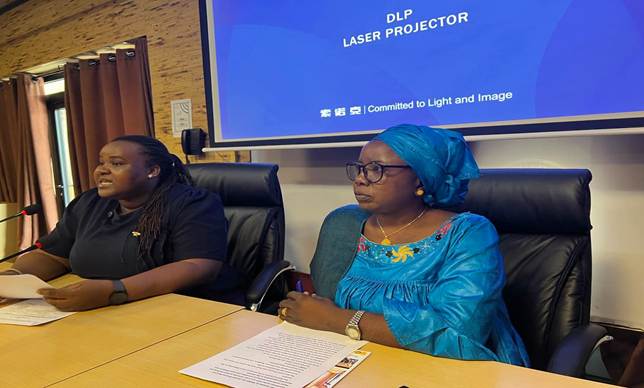
Members of CJID, WANEP, EU On The High Table
By: Isatou Jawara
The Centre for Journalism Innovation and Development (CJID), in partnership with the European Union (EU) and the West Africa Network for Peacebuilding (WANEP), has taken a proactive step by training Gambian journalists in digital verification. They emphasized that misinformation, disinformation, and hate speech pose serious threats to peace and can erode public trust as the country approaches its presidential election on December 5, 2026.
The organizations are calling on journalists to enhance their fact-checking efforts, verify digital content, and commit to responsible reporting. This is crucial for safeguarding the integrity of the electoral process and ensuring peaceful elections.
This appeal was made during a two-day digital verification workshop hosted by CJID in collaboration with WANEP-The Gambia, funded by the EU as part of the Electoral Violence Monitoring, Analysis and Mitigation (E-MAM) Project. The workshop gathered 25 journalists at the Bakadaji Hotel.
During the workshop, EU Attaché Pablo Padin Perez warned that the spread of false information on social media could significantly undermine public confidence in the electoral process. He urged journalists to thoroughly verify sources, images, and videos before sharing them, especially during the election period.
Salama Njie, the National Network Coordinator for WANEP-The Gambia, pointed out that misinformation, disinformation, and hate speech have become potent tools for distorting facts, manipulating voters, and exacerbating ethnic and political divisions.
She stressed that the integrity of elections relies not just on what occurs at polling stations but also on the quality of information available to voters before, during, and after the elections.
Njie highlighted that elections are a cornerstone of democracy, allowing citizens to reaffirm the social contract between the state and its people. However, she cautioned that the democratic process is at risk when voters base their decisions on false or manipulated information.
“We are living in a digital age where information travels at lightning speed, and it’s crucial that we stay vigilant.”
Njie emphasized that journalists have a crucial role to play, urging them to go beyond simply repeating what political figures say and to verify claims before sharing them with the public.
She also highlighted the importance of bolstering the capabilities of civil society organizations, government institutions, and intergovernmental bodies to ensure peaceful elections and maintain political stability.
The E-MAM Project spans 12 West African nations, including The Gambia, Senegal, Ghana, Guinea, Guinea-Bissau, Burkina Faso, Benin, Mali, Niger, Liberia, and Côte d’Ivoire. Its goal is to enhance both regional and national capacities for fostering peaceful elections and political stability.
A representative from CJID reiterated the organization’s dedication to advancing democracy and development throughout Africa by leveraging journalism, innovation, and open data.
Established in 2014 and based in Nigeria, CJID operates in over 15 African countries, providing support to media institutions and journalists to promote democratic accountability and inclusive, sustainable development.
The organization runs various programs, such as the Media in National Elections Project (MiNE), which aims to strengthen the media’s influence in electoral processes, and UDEME, an accountability initiative that empowers citizens to track government performance and evaluate whether elected officials fulfill their promises beyond election time.
CJID also engages in multiple development sectors, including health, extractives, conflict and security, human rights, food security, agriculture, and climate change. Its journalism training programs aim to connect academia with the media industry, while its media freedom initiative documents attacks on press freedom and advocates for a safer environment for journalists.