By: Ousman A. Marong
Team Gambia flag-bearer Lamin J. Dabo, says good governance, transparency and respect for the rule of law would be his administration’s top priorities. He argues that the country cannot tackle its development challenges without first addressing weaknesses in its governance system.
Dabo, a Gambian constitutional and human rights lawyer, shared his views while answering questions about his political ambitions, experience and policy priorities as he seeks to lead the country.
He said Gambians have had more than a decade to follow his work and public engagements since he returned to The Gambia full-time in January 2015.
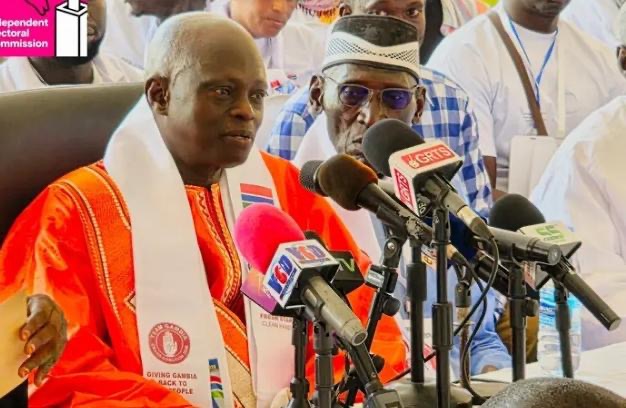
Photo: Dobo and Sidia Jatta, PDOIS Founding Member
Since then, he said, his trips to the United Kingdom have mostly been occasional visits during High Court vacations.
“I believe Gambians have had the opportunity to see me in action over the past 11 – years. I returned to the country full-time and have resided here since January 2015. Once in a while, for a month, perhaps three weeks or six weeks during the High Court vacations, I would travel to the UK, of which I was a citizen. Those are the only times I travel outside the country,” he explained.
Dabo, made the utterances while speaking to journalists at the Independent Electoral Commission (IEC), where he submitted his nomination papers.
The born added that anyone who has followed public affairs over the years would have had a chance to understand who he is and what he stands for.
Dabo declined to compare himself with other political figures, saying his record and public engagements should speak for themselves.
Good Governance Tops Team Gambia’s Priorities
Setting out his priorities, the human rights lawyer put good governance at the heart of his political agenda. He said the country must first build a system based on transparency, accountability and respect for the rule law.
“My priorities for the Gambian people would be governance, governance and governance — good governance, of course. That has to come first because, at the end of the day, no matter what you do for this country, it will continue to stagnate as it has since 1965 if it isn’t governed transparently and in accordance with the law,” he said.
He said tackling the country’s governance challenges would lay the groundwork for progress in other sectors, and stressed the need to strengthen the institutions through which the country is governed.
“We have to work on the country’s governance infrastructure. Once we get that right, the rest will be automatic,” he remarked.
The Team Gambia flag-bearer also said his proposed administration would put citizens’ dignity and rights at the heart of governance, with respect for the rule of law as a guiding principle.
Dabo Yet to Clearly State Position on FGM
On the contentious issue of Female Genital Mutilation (FGM), the constitutional lawyer acknowledged that he had not yet stated his position clearly in public.
He said his work as a lawyer has largely involved handling legal matters raised by clients, while addressing such issues in government would require a different approach.
“Well, on FGM, I have never stated my position clearly. What I do, like any lawyer, is deal with the issues clients bring to me. When we come into government, we will be in a better position to address those issues with times,” he stressed.
On TRRC Recommendation
His comments leave his precise position on the controversial practice unclear.
TRRC Recommendations Must Be Guided by Evidence, Says Dabo
On implementing the recommendations of the Truth, Reconciliation and Reparations Commission (TRRC), Dabo said any effort to prosecute people implicated in human rights violations under the former regime must be based on evidence.
He described the TRRC process as adversarial and said the evidence needed to secure convictions must be carefully assessed before anyone is brought to court.
“The TRRC was an adversarial process, so we have to look closely at the evidence. Do we have enough to put people on trial? Do we have the necessary evidence? It’s not as simple as it may be seen,” he argued.
He further stressed that evidence used to prosecute those accused of atrocities must be strong enough to withstand scrutiny in court.
“We would have to rely on evidence that can stand up to scrutiny in court to prosecute those said to be responsible for atrocities committed between 1994 and January 2017,” he added.
His position highlights the need to pursue accountability through the TRRC process while upholding due process and the rule of law
Background:
Lamin J. Dabo, is a Gambian constitutional lawyer from Gunjur, and is not related to UDP leader Ousainou Darboe. Before entering law, he worked as a journalist, banker and Action-Aid staffer. He studied law in the US and UK, was called to the Bar of England and Wales in 2001, and later served as a magistrate in Banjul and Brikama. A longtime UDP member, he sought the party’s flag-bearer ticket in 2021 and 2026 but did not make the final shortlist. His 2026 bid was briefly delayed over his British dual citizenship.
He later left the UDP and became leader of the National Unity Party on 31 October 2025. To meet the requirements of Section 62 of the Constitution, he renounced his UK citizenship. As NUP leader, he signed an MoU on 4 August 2026 with Talib Ahmed Bensouda’s UNITE Movement for Change (UMC/UNITE), forming Coalition 2026 with Bensouda as flag-bearer. The partnership later faltered, and Dabo joined Team Gambia Grand Coalition 2026. On 3 November 2026, the coalition named him its presidential candidate for the 5 December election, with a pledge to serve only one five-year term. He then stepped down as NUP leader to run as an independent under Team Gambia.