By Isatou Jawara
The Gambia’s public health system has undergone significant transformation through community-based interventions, scientific research, digital innovation and evidence-driven policies, according to Africa CDC National Coordinator for the Western Region Coordination Centre, Mr. Modou Njie.
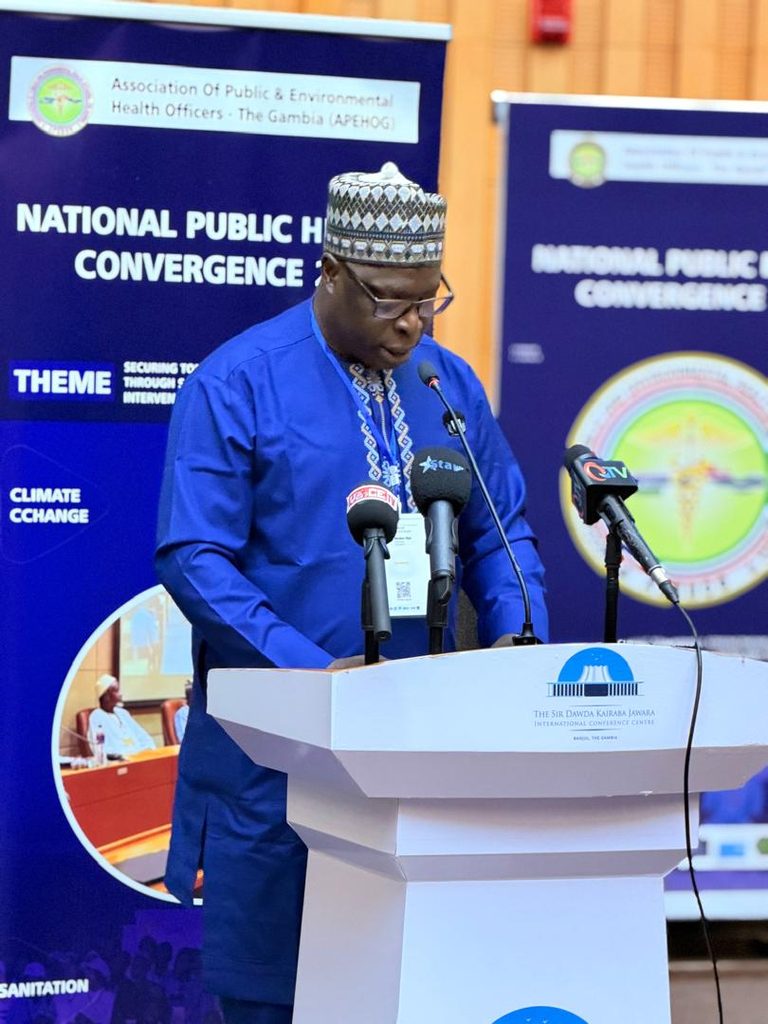
Speaking at the National Public Health Convergence 0.2 held in The Gambia under the theme, “Securing Tomorrow: Strengthening Public Health through Science, Innovation, and Sustainable Interventions in The Gambia,” Njie highlighted several initiatives that have contributed to the development of public health practice and the country’s health system.
Reflecting on his own experience in public health education, Njie recalled introducing community diagnosis field exercises in 2008 while serving as a volunteer visiting lecturer at the then School of Public and Environmental Health of Gambia College, now the University of Education, The Gambia.
The field exercises took public health trainees to communities in Foni Kansala, Foni Bintang Karanai and Bondali, exposing them to different cultures and the challenges communities face in accessing healthcare.
Njie said the initiative was based on the conviction that public health education should extend beyond the classroom and allow students to interact directly with communities.
The programme subsequently became an annual activity on the school’s academic calendar, with students investigating issues including infant feeding, water, sanitation and hygiene, childhood disease prevention, environmental sanitation and health-seeking behaviour.
Students collected data from communities and presented their findings to the school community, providing them with practical experience in community-based research and evidence generation.
Njie said the initiative later provided a foundation for further innovation. In 2019, Dr. Amadou Barrow, Mr. Solomon P. S. Jatta, Mr. Musa Nget and their team developed the Community Outreach Program, strengthening data collection instruments, introducing digital data collection and incorporating more robust data analysis.
The programme subsequently contributed to more than seven scientific publications in international journals, including BMC Public Health, PLOS ONE, BMJ Open, Journal of Tropical Medicine and Advances in Public Health.
Njie described the development as an example of how public health innovations can evolve when subsequent generations build on earlier initiatives and use science and technology to strengthen them.
He also highlighted several community-based interventions that have contributed to health promotion and disease prevention in The Gambia.
Among these was the Tippy Tap, a low-cost handwashing device that was promoted at community level with support from development partners and later scaled up by the Ministry of Health.
The intervention became particularly important during the Ebola outbreak in West Africa and the COVID-19 pandemic, when hand hygiene was promoted as an essential measure for preventing disease transmission.
Njie also recalled community nutrition initiatives that were initially piloted in 12 communities in the Lower River Region before being expanded to other parts of the country.
The initiative involved recruiting and training village support groups to promote nutrition, health and sanitation within their communities.
He further cited the “Yewtereh,” “Endu” and “Bantaba” initiatives implemented under the Participatory Health, Population and Nutrition Project as examples of approaches that encouraged community dialogue and participation in health, population and nutrition interventions.
The Mother MUAC initiative, implemented by the Ministry of Health in collaboration with the National Nutrition Agency, was also highlighted as an example of community innovation.
The programme equipped mothers and caregivers with knowledge and tools to identify children at risk of acute malnutrition.